
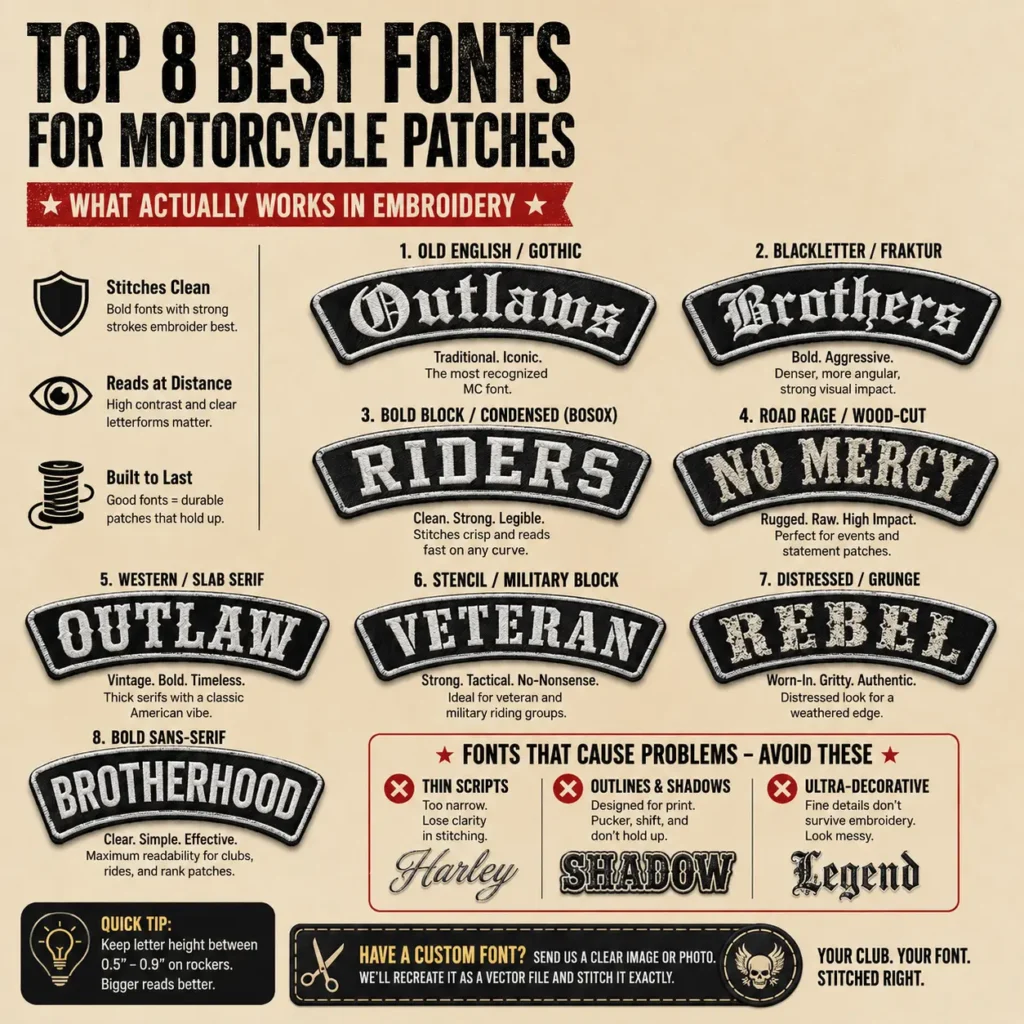
TL;DR: Old English and bold block fonts are the most widely used on MC patches because they stitch cleanly and read well at distance. Avoid thin scripts, outlines, and decorative fonts on small patches — they fall apart in embroidery. And if your club has a custom font nobody else uses? We can recreate it as a vector file and stitch it exactly. More on that below.
Choosing a font for your motorcycle patch is not a design exercise. It is a practical decision. A font that looks great on a screen can become an unreadable mess once it is stitched onto a rocker at half an inch tall.
This guide covers the top 8 fonts that work, which ones to avoid, and why the difference matters more than most people realize before they place an order.
If you are still working out the overall patch layout — rockers, center patch, MC cube placement — read our MC patch layout and design guide first, then come back here for the font decisions.
Why Font Choice Matters More on Patches Than Anywhere Else
Embroidery works in thread, not pixels. Fine details, thin strokes, and decorative flourishes do not translate the same way. What looks sharp in your design file can turn into a blurry, thread-heavy mess in production.
The stakes are higher on motorcycle patches specifically. Rockers are curved. Letters are often under an inch tall. Your patch will be read by people at distance — not up close on a screen.
Get the font wrong and your club name looks like noise.
This is one of the most repeated complaints across biker communities and buyer reviews: orders arrive with letters too thin to read, stitches merged along the curve, or text that looked clean in the proof but fell apart on the finished patch. The font choice — and how it is digitized — is almost always the reason.
The Top 8 Best Fonts for Motorcycle Patches
1. Old English / Gothic
The most recognized style in MC culture. Heavy strokes, traditional feel, immediately reads as biker. Old English has been stitched on patches for decades because it holds up well at mid-to-large sizes and carries the weight of MC tradition behind it.
Patch suppliers consistently report it as their most-requested font for top and bottom rockers. Rank patch sellers stock it as a dedicated category because demand never drops.
Best for: Top and bottom rockers, center patches with a traditional look.
Watch out for: Letter height under 0.5 inches. Gothic letters start losing definition fast at small sizes. The thin inner strokes are the first thing to disappear in stitching.
2. Blackletter / Fraktur
Often confused with Old English but heavier and more dramatic. Where Old English feels traditional, Blackletter feels aggressive. The letterforms are denser, more angular, and command more visual space — which is why it is popular among clubs that want a harder edge than standard Gothic delivers.
FontAdvice.com describes it directly as “reminiscent of classic biker patches, emphasizing tradition and unity among club members.” FontBundles lists it as its own dedicated biker font category.
Best for: Center patches, one-piece back patches, clubs that want a stronger visual presence than Old English.
Watch out for: Blackletter is difficult to read at speed if the digitizing is loose. Every stroke needs to be clean or the whole word becomes a dark smear. Experienced digitizing is non-negotiable here.
3. Bold Block / Condensed Block (Bosox)
Clean, strong, and highly legible. Not as ornate as Old English but it stitches crisply and reads fast — even on a curved rocker. If your club name is long and you need to fit it cleanly without crowding, condensed block is usually the smarter call.
Bosox is the most mentioned name in this category across patch communities — specifically because it was designed with curved embroidery in mind, not adapted from a print font.
Best for: Rockers with long text, center panels, officer patches, modern club aesthetics.
Watch out for: Going too condensed. Very narrow letterforms can compress stitch lines and cause puckering along the curve.
4. Road Rage / Wood-Cut Style
Rugged, raw, high contrast. These fonts carry visual weight and stand out. Popular for event patches, outlaw-themed designs, and one-percenter imagery. Road Rage consistently comes up in patch community discussions as a high-impact choice — but with a clear warning attached: it demands experienced digitizing.
Best for: Event patches, rally patches, statement designs.
Watch out for: High stroke contrast means the thin parts of each letter are fragile in embroidery. Cheap digitizing causes thread breaks. Do not use this font with a low-cost vendor.
5. Western / Slab Serif
Think vintage Americana — thick serifs, wide letterforms, built for visibility. FontAdvice.com describes this style as “a Western-style woodcut font that brings a vintage, outlaw spirit to Motorcycle Club emblems” and “a chunky, shadowed slab serif based on traditional woodtypes, giving a robust and timeless feel to Motorcycle Club branding.”
Western fonts have a natural crossover with biker culture and sit between bold block and Old English in terms of formality. They stitch well at larger sizes.
Best for: Event patches, rally commemoratives, riding clubs with a vintage American identity. Works especially well on wide one-piece back patches where there is room to breathe.
Watch out for: The thick serifs look great large but start merging at small sizes. Keep letters at 0.6 inches minimum. Avoid anything with decorative borders built into the letterform — those disappear in thread.
6. Stencil / Military Block
Straight edges, no-nonsense, maximum authority. Stencil fonts are the go-to for veteran biker clubs and military riding groups specifically. The alibaba motorcycle font guide confirms it directly: “Military veteran group: Condensed serif or modified military stencil with subdued colors.”
They digitize cleanly, hold up at small sizes better than most decorative fonts, and communicate a specific identity that Gothic simply does not.
Best for: Veteran MC chapters, military riding clubs, name bars, tactical-themed patches.
Watch out for: They can look generic without a strong graphic to anchor the design. The font alone will not carry the patch — pair with a bold center image.
7. Distressed / Grunge
A step beyond Road Rage. Distressed fonts look like the letters have been through weather, road rash, and a few hard miles. The roughed-up texture gives a patch an aged, earned quality that feels authentic rather than designed.
The alibaba biker patch font guide confirms the category: “If making a bold statement → Road Rage or distressed variant.” FontAdvice.com describes the style as adding “a raw, DIY, and defiant edge to Motorcycle Club designs.”
Best for: Solo rider patches, event patches, one-piece back patches meant to look worn-in.
Watch out for: The distress effect relies on fine surface texture that embroidery cannot reproduce at small sizes. These fonts only work large — center back patch territory, not a 2-inch side patch. At small scale they look like a production error, not style.
8. Bold Sans-Serif
No attitude, maximum readability. Bold sans-serif fonts are the right call when the goal is clarity over style — charity rides, riding clubs, officer identification, informational patches. Christian biker groups and safety campaigns consistently lean on these because legibility is the priority.
Best for: Non-MC groups, riding clubs, rank identifiers, large text on smaller patches.
Watch out for: They look plain without a strong graphic around them. Pair with a bold center design or the patch risks looking like a name tag.
Fonts That Cause Problems — Avoid These
Thin scripts and calligraphy. The strokes are too narrow. They lose clarity immediately in stitching and look muddy on the finished patch. This is the single most repeated complaint in custom patch buyer feedback.
Fonts with outlines or shadows baked in. These are designed for print. In embroidery, the outline becomes a separate run of stitches that frequently puckers or shifts out of alignment.
Ultra-decorative display fonts. If a font relies on tiny details to look good, those details will not survive production. Anything with a stroke thickness under 0.5mm is a real risk.
Free fonts with no digitizing quality control. Many produce embroidery files that skip stitches, misalign on curves, and fall apart after washing. DaFont.com is generally safer — patch makers themselves recommend it — but digitizing quality still determines the final result regardless of where the font comes from.
A simple rule: if you cannot read it clearly at thumbnail size, it will not stitch well.
Letter Height — The Number People Get Wrong
This is where most rocker orders go sideways.
For embroidered text on a curved rocker, capital letters should sit between 0.5 inches and 0.9 inches tall. Below 0.5 inches, thin typefaces start losing definition. Above 0.9 inches, you are eating into border space.
If your club name is long, widen the rocker slightly. Do not shrink the text to fit. Smaller text on a curved surface reads worse than people expect from the digital proof.
Leave 0.25 to 0.4 inches of border space so the edge does not crowd your lettering. Keep 0.5 to 0.75 inches of breathing room between your top rocker, center patch, and bottom rocker so the full set reads as intentional — not compressed.
Before you finalize your font, make sure your rocker dimensions are locked in first. Our motorcycle vest rocker patch size guide covers exact sizing for top and bottom rockers, side rockers, and name tags — all in one place.
Technical Specs to Check Before You Order
Beyond the font name, these factors directly affect how your patch turns out:
- Stroke thickness — Avoid letters with ultra-thin lines under 0.5mm. They may not stitch cleanly at all.
- Letter spacing — Tight kerning can cause letters to merge during sewing. Aim for consistent gaps.
- Curve handling — Some fonts distort badly when bent into a rocker arc. Test how the font looks on a curve before committing.
- Digitizing quality — A good embroidery file includes proper jump stitches, underlay, and density control. This is not visible in a proof. Ask your vendor directly.
🎯 Bonus: Have a Custom Font? We Can Build It.
Some clubs have a font that is completely their own — something hand-drawn years ago, pulled from an old patch, or something that does not exist anywhere online.
You do not have to abandon it.
If you send us a clear image or photograph of the lettering, our team can recreate it as a vector file during the digitizing process. We trace the letterforms, clean up the shapes, and convert them into production-ready artwork that stitches accurately.
Your club keeps its exact identity — not a close substitute, not a similar font. The real thing, rebuilt properly so it stitches clean every time.
Just mention it upfront when you reach out so we can factor it into the timeline.
What to Tell Us When You Order
To get your font right the first time, share the following:
- The font name, if you know it
- A reference image of the text, if you have one
- Patch type — rocker, center patch, officer patch, etc.
- Approximate size of the finished patch
- Whether you want the text curved or straight
- If you have a custom font, the clearest photo or scan you can provide
If you do not know the font name, that is fine. Send the image and we handle the rest.
Final Thoughts
Font choice on a motorcycle patch is not decoration. It is legibility, durability, and identity — all in one decision.
Go bold. Go readable. Keep letter height in range. And if your club has something unique that no font library carries, do not guess at a substitute. Send it to us and we will rebuild it correctly.
Get a quote on custom motorcycle patches and tell us what you have in mind.