
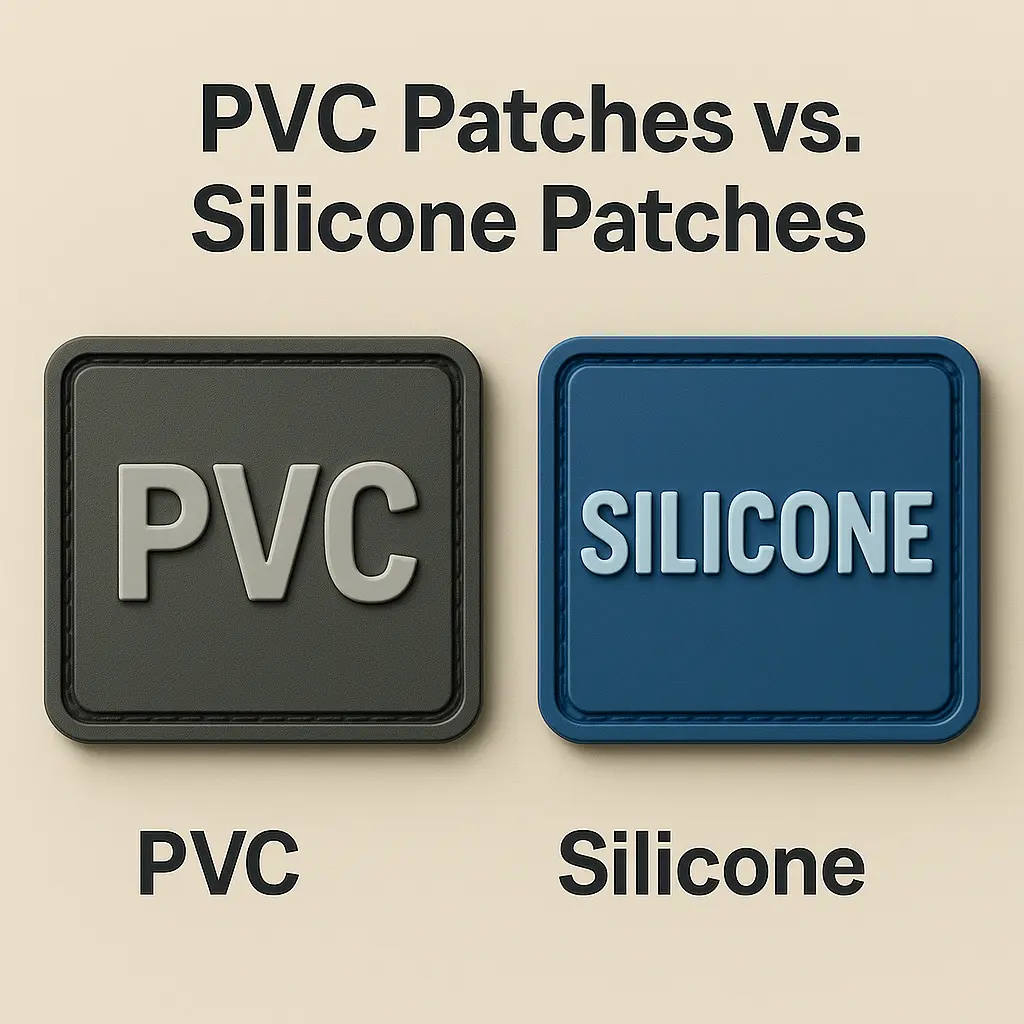
Quick Answer:
- PVC patches are firmer, more affordable, easier to sew, and maintain their shape
- Silicone patches offer flexibility and heat resistance (-60°C to 200°C)
- For sewing → PVC
- For harsh environments → Silicone
You’re comparing two patches—one’s PVC, the other’s silicone. They look similar, but they’re fundamentally different materials with distinct properties.
This article compares both materials across temperature resistance, durability, sewing compatibility, and long-term performance.
What Is a PVC Patch?
PVC stands for polyvinyl chloride—a synthetic thermoplastic polymer used in modern patch manufacturing. These patches are produced through a precision injection process using polyvinyl chloride, plasticizers, and pigments.
The material consists of three layers: a protective lacquer topcoat, a middle polyvinyl chloride layer, and a rear adhesive backing. This layered construction creates the firm, three-dimensional structure characteristic of PVC patches.
What Is a Silicone Patch?
Silicone patches are manufactured from silica gel—a synthetic polymer with a porous molecular structure. Production involves mixing silica gel with color masterbatch, then heat-and-pressure molding under controlled conditions.
Unlike PVC, silicone maintains elasticity across extreme temperature ranges. The material remains flexible and stretchable while resisting environmental degradation.
Both materials are used for durable, waterproof, customizable patches, but their performance differs significantly.
PVC vs. Silicone: Material Comparison
| Property | PVC Patches | Silicone Patches |
| Surface Texture | Firm, matte to semi-gloss | Soft, smooth, high-gloss |
| Temperature Range | -10°C to 45°C | -60°C to 200°C |
| Flexibility | Rigid, maintains shape | Highly elastic, stretchable |
| Sewing Compatibility | Strong — resists needle damage | Not ideal — prone to tearing under needle pressure |
| Application Method | Sew-on, adhesive-backed | Heat press recommended |
| UV Resistance | Moderate — yellows over time | High — maintains color |
| Weather Resistance | Good for indoor/moderate outdoor | Better for extreme conditions |
| Cost | Lower | 20–30% higher |
| Typical Use | General apparel, promotional items | Technical gear, extreme environments |
This table shows that PVC excels in sewing and cost efficiency, while silicone excels in flexibility and environmental performance.
Performance Comparison
Temperature Tolerance
PVC patches function within a limited temperature range. The material becomes brittle below -10°C and softens above 45°C, causing deformation.
Silicone patches operate continuously from -60°C to 200°C without structural degradation. This makes silicone suitable for industrial applications and extreme sports gear (Source: Dow Silicone Material Data Sheet, Product Technical Library).
Durability and Weather Resistance
Silicone demonstrates higher resistance to ultraviolet radiation and ozone exposure, maintaining structural integrity and appearance under prolonged sunlight and moisture.
PVC patches perform well in controlled environments but show degradation under extended UV exposure. The material may yellow or lose flexibility when exposed to sunlight and heat. For indoor applications or short-term outdoor use, PVC provides suitable durability.
Water and Chemical Resistance
Silicone maintains high water resistance with minimal absorption and remains stable in moisture without swelling or weakening.
PVC offers moderate water resistance suitable for most apparel and everyday applications. However, prolonged moisture and heat exposure can affect surface quality (Source: Polymer Plastics Encyclopedia, Materials Section).
Appearance Over Time
Silicone resists discoloration and surface degradation even under harsh conditions. As a result, silicone maintains a consistent smooth, glossy appearance throughout its service life.
Custom PVC patches retain appearance well under normal use. However, exposure to light and heat may cause surface yellowing.
Application Methods
Sewing PVC Patches
PVC’s rigid structure makes it compatible with standard sewing techniques. The material withstands needle penetration without tearing or deforming. Thread holds securely, and the patch maintains shape during and after application.
Applying Silicone Patches (Heat Press)
Silicone’s flexibility creates challenges for sewing applications. High needle pressure can cause material damage. Heat press application provides optimal bonding without these risks.
Manufacturing Process
PVC patches undergo precision injection molding. Raw polyvinyl chloride, plasticizers, and color pigments are heated, injected into molds, then cooled.
Silicone patches use heat-and-pressure molding. Silica gel mixed with color masterbatch is placed in heated molds and compressed. After curing, the material is demolded and finished.
Cost Analysis
Silicone patches cost 20-30% more than equivalent PVC patches due to higher raw material costs. PVC offers lower per-unit pricing for large orders. Silicone may outlast PVC in outdoor applications, narrowing the long-term cost difference.
Material Selection Guide
Choose PVC Patches When:
- Sewing directly onto fabric
- Working with moderate budgets or large quantities
- Application is primarily indoor or light outdoor use
- Shape retention and structural rigidity are priorities
- Temperature exposure stays within -10°C to 45°C
- Project timeline requires quick turnaround
Choose Silicone Patches When:
- Extreme temperature exposure is expected (-60°C to 200°C)
- Patches will face prolonged UV and weather exposure
- Maximum flexibility and elasticity are required
- Application is in food service, medical, or industrial settings
- Long-term outdoor durability is critical
- Heat press application is preferred or required
Pros & Cons Summary
Viewing both materials side-by-side highlights their strengths and limitations.
PVC Advantages:
- Lower cost
- Easy to sew
- Maintains rigid shape
- Wide color availability
- Faster production times
PVC Limitations:
- Limited temperature range
- UV degradation over time
- May yellow with age
- Less flexible
Silicone Advantages:
- Extreme temperature tolerance
- Higher UV and weather resistance
- Retains appearance longer than PVC
- Highly flexible and stretchable
- Food-safe and medical-grade options
Silicone Limitations:
- Higher cost
- Difficult to sew
- Requires heat press application
- Longer production time
Final Assessment
Both materials serve distinct applications effectively. PVC patches provide cost-effective, durable solutions for general apparel, promotional items, and moderate-use applications. The material’s rigidity and sewing compatibility make it practical for most customization projects.
Silicone patches perform well in demanding environments requiring temperature extremes, UV resistance, or extended outdoor exposure. The material’s flexibility justifies higher costs for technical gear and industrial applications.
Material selection should be based on specific application requirements: temperature exposure, attachment method, environmental conditions, and budget constraints. Users selecting patches for long-term outdoor or industrial use should prioritize silicone, while most general-use sewing applications remain better suited to PVC. There is no universally superior option; performance depends entirely on matching the material to the intended environment and application.
Summary: PVC patches offer firm structure, lower cost, and easy sewing application for everyday use. Silicone patches provide temperature tolerance (-60°C to 200°C), UV resistance, and longer lifespan in harsh conditions at 20-30% higher cost. Choose PVC for general apparel and promotional items. Choose silicone for extreme environments, technical gear, and applications requiring maximum weather resistance. Material selection depends on temperature range, attachment method, environmental exposure, and budget rather than one material being universally better.
Not sure whether PVC or silicone suits your application? Share your use case and we’ll help you choose between our custom hat PVC patches and other material options based on durability, temperature exposure, and sewing requirements.
About the Author: Fred has over 7 years of hands-on experience manufacturing PVC, silicone, embroidered, and woven patches for apparel brands and industrial clients. His assessments combine real-world production insight with polymer material research to help readers make informed material decisions.