
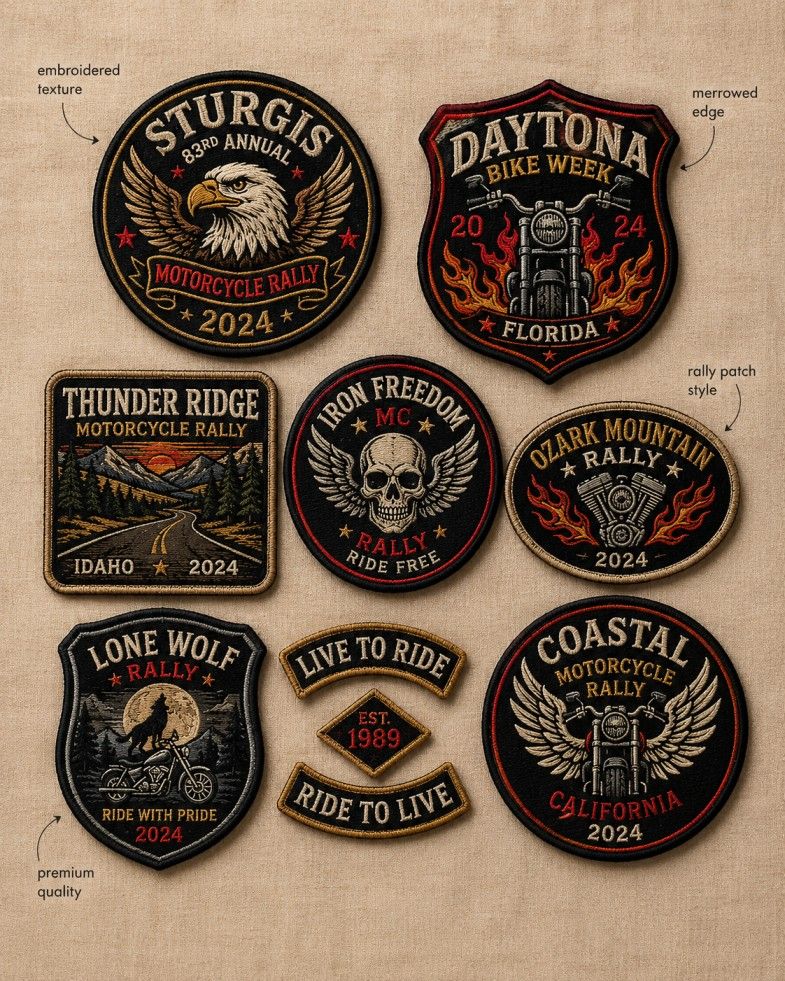
TL;DR: Rally patches are not the same as club patches. They are event-specific, date-stamped, and meant to be collected — not regulated. If you are attending Sturgis, Daytona, or any local run this season, ordering custom patches ahead of time is smarter and cheaper than buying whatever is left at the vendor booth. Here is what you need to know.
At Teddy Patches, we produce custom patches for motorcycle rallies and events year-round — from small 30-rider chapter runs to multi-thousand-piece orders for major national events. After producing patches for riders heading to Sturgis, Daytona Bike Week, local charity runs, and everything in between, one pattern shows up consistently: groups that plan their patches early get exactly what they want. Groups that wait end up rushing, compromising on design, or paying more for expedited production.
This guide is built from that production experience. It covers what rally patches actually are, which patch type fits which event, how to time your order, and the design decisions that matter — so you do not find out what went wrong after the patches arrive.
If you ride, you already know the patch on your vest outlasts everything else from an event. The t-shirt fades. The sticker peels. The patch stays. That is exactly why it is worth getting right.
What Makes a Rally Patch Different
Club patches carry membership and identity. Rally patches carry memory and dates.
A rally patch usually includes:
- The event name or run name
- The year or specific date
- A location reference (city, state, or route)
- Sometimes a mileage marker or participant count
They are collectible by design. Riders who attend the same event every year often stack the patches on their vest in order. It becomes a timeline of rides.
This is a completely different use case from a rocker or a center patch. There are no rules around placement, no club approval needed, and no unspoken etiquette to navigate. Rally patches are purely personal.
Who Orders Rally Patches
It is not just clubs. Across the rally patch orders we process at Teddy Patches, the buyers break down into four main groups:
Event organizers who want something to hand out or sell at registration. A custom patch adds perceived value to an entry fee and gives attendees something to take home.
Riding chapters that attend events as a group and want a shared memento that marks the occasion. These are often ordered in runs of 25–100 pieces.
Independent riders who attend solo but want to document the event on their vest. These are typically smaller orders.
Sponsors and vendors who set up at rallies and use patches as branded giveaways. A patch on someone’s vest is visibility that lasts for years.
If you fall into any of these categories, ordering custom makes more sense than buying generic. The cost difference at even moderate quantities is significant, and you control what goes on it.
What Type of Patch Works Best for Rallies
Not every patch type fits rally use the same way. Based on what we see ordered most for events, here is how they break down:
Embroidered Patches
The most common choice for rally and event patches. They hold up through outdoor conditions, repeated wear, and washing. Thread colors stay vibrant. If you want something that looks like a traditional biker patch, custom embroidered patches are the standard starting point.
PVC Patches
A growing choice for rallies, especially for outdoor events with exposure to heat, rain, and dust. PVC does not absorb moisture, does not fray, and holds fine detail well. If your design has sharp edges, small text, or gradient-style shading, custom PVC patches handle it better than embroidery.
Woven Patches
Good for designs with small, intricate text or fine line art. The weave captures detail that embroidery thread cannot always hold cleanly. Worth considering if your rally logo has a detailed illustration or tight lettering.
Leather Patches
Less common for events but increasingly popular for premium rider groups. A custom leather patch signals quality and tends to be kept longer than a standard embroidered version.
For most rally organizers ordering in volume, embroidered or PVC will be the right call. Both are durable, affordable at quantity, and deliver a clean result.
Backing Options: What to Choose
Rally patches get applied to vests, jackets, bags, and hats. The backing you choose affects how easy that is.
Iron-on backing is the most convenient for end users. They apply it themselves with a home iron or heat press. Good choice if you are handing patches out at registration.
Sew-on backing is more durable long-term. Preferred by riders who want their patches to last through years of wear without any edge lifting.
Velcro backing is popular with riders who like to swap patches between gear. If your audience skews tactical or military-adjacent, Velcro is expected.
If you are unsure which backing to choose for your audience, iron-on is the safest default for event distribution. Riders who want a permanent hold can always sew over it.
Sizing for Rally Patches
Rally patches do not follow a strict sizing convention the way club patches do. That said, a few sizes tend to work consistently:
- 3 inches — hat patch, jacket sleeve, or small bag placement
- 4 inches — standard vest placement, readable at a short distance
- 5–6 inches — center back placement or large statement patch
- 12 inches — full back panel for events that go big
Most event patches land between 3 and 5 inches. If your design has a lot of detail or text, go larger rather than smaller. Small patches with too much information end up unreadable.
Planning Your Order: Timing Is Everything
This is where most groups make the same mistake. They start thinking about patches two weeks before the event — and we see this rush constantly on the production side. It compresses every decision and leaves no room for proof revisions or shipping delays.
Here is a realistic timeline:
| Time Before Event | What You Should Be Doing |
| 8–10 weeks out | Finalize your design, get a quote, submit artwork |
| 6–8 weeks out | Approve your digital proof, confirm quantity |
| 4–6 weeks out | Production underway |
| 2–3 weeks out | Patches arrive, you have time to check quality |
| 1 week out | Distribution prep, any last sorting or bagging |
Standard production at Teddy Patches runs 7–14 business days from proof approval. If you need rush production, that option exists — but it costs more and adds pressure. Give yourself runway.
Design Notes That Actually Matter
Rally patches are often designed by committee, which creates problems. Here is what we see cause the most issues in production:
Less detail reads better at size. A patch is not a poster. Complicated backgrounds, thin lines, and small text are the first things that suffer in production.
Year and location should be easy to read. These are the two things riders look at when they see another rider’s patch. Make them legible.
Limit your color count if you want to keep cost down. Embroidery pricing can increase with thread color complexity. A clean 4–6 color design is usually the sweet spot for rally patches.
High contrast works. Dark background with light lettering, or vice versa. Avoid mid-tones stacked on mid-tones.
If you are submitting artwork, vector files (AI, EPS, or high-resolution PDF) give the cleanest result. If all you have is a JPEG or PNG, send the highest resolution version you have and the production team will work with it.
Common Mistakes to Avoid
- Ordering too close to the event date. Production plus shipping takes time. Two weeks is not enough lead time for a first-time order. We have had groups contact us 10 days out — we do our best, but the options narrow fast.
- Underestimating quantity. Leftover patches are not a loss — they sell at future events or become trading material. Running short at registration is a worse problem.
- Skipping the proof approval step. Always review your digital proof before production starts. A name spelled wrong or a color that does not match is fixable before production, not after. Once it goes to production, it cannot be undone.
- Choosing the wrong backing for your audience. If your attendees are mostly casual riders, iron-on is fine. If they are experienced patch collectors, they may prefer sew-on from the start.
- Going too small on size. A 2-inch rally patch with a busy design will look muddy. When in doubt, size up.
Quality Matters at Events
A rally patch represents your event or your group long after the weekend is over. Riders keep them on vests for years. The quality of the stitching, the edge finish, and the color accuracy all get noticed — especially when someone picks up another rider’s vest patch to look at it closely.
Focus on:
- Clean merrowed edge (no fraying)
- Accurate color match to your design
- Consistent backing application across the full order
- Readable text at the intended display size
If you are comparing vendors, ask for a sample of their embroidered work before committing a large quantity. The difference between a cheap patch and a well-made one is visible.
Frequently Asked Questions
How many patches should I order for a motorcycle rally? Order at least 10–15% more than your expected attendance. Running out mid-registration is a harder problem than having extras. Leftover patches typically sell at future events or get used as giveaways. For a 100-rider event, ordering 115–120 patches is the safer move.
What is the minimum order quantity for rally patches? At Teddy Patches, there is no minimum order requirement. Small chapter runs of 10–20 patches are as welcome as bulk event orders. Pricing per patch does improve at higher quantities, so groups often find it cost-effective to order slightly more.
How long does it take to get custom rally patches made? Standard production runs 7–14 business days from the time your proof is approved. Add shipping time on top of that. Start the process 8–10 weeks before your event to give yourself proper runway for revisions, production, and delivery.
Can I order rally patches without a design file? Yes. If you have a rough sketch, a reference image, or even just a description of what you want, the team at Teddy Patches can help develop the artwork. Vector files give the cleanest result, but they are not required to start.
What size patch works best for a motorcycle event? 4 inches is the most common size for vest placement — readable, proportional, and easy to apply. If your design has a lot of text or detail, 5 inches gives more room to work with. Hat patches typically run 3 inches or smaller.
What is the difference between iron-on and sew-on backing for rally patches? Iron-on is more convenient for distribution — attendees apply it themselves at home. Sew-on holds longer over years of hard wear and washing. Many experienced riders prefer sew-on for anything they plan to keep permanently. If you are handing patches out at an event, iron-on is the practical default.
Rally patches are one of the few things from an event that actually stick around. They end up on vests, bags, and display boards for years. Getting the design right, the backing right, and the timing right is worth the planning.
Order early, check your proof, and choose a patch type that matches what your riders actually wear. The rest takes care of itself.
If you are ready to start your event patch order, you can review options and get a quote at Teddy Patches.