
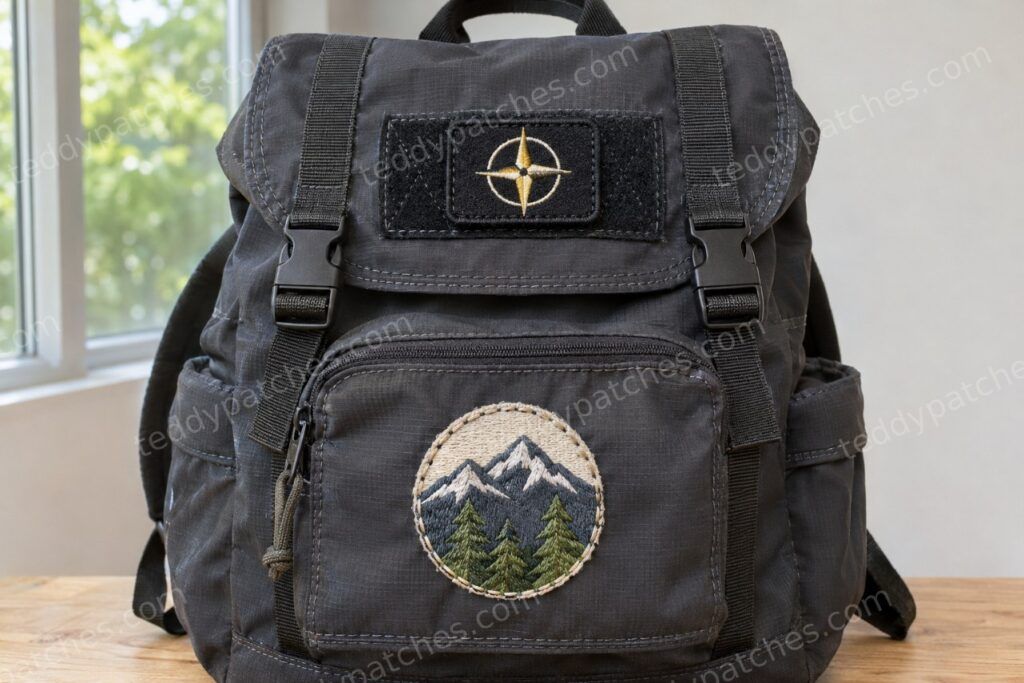
The two ways to put a patch on a backpack that actually last are sewing it on or using a Velcro (hook-and-loop) backing. Sewing is permanent and survives rain, weight and years of daily use. Velcro lets you swap patches whenever you want, and the loop panel is sewn on once.
Both methods work on nylon, polyester, canvas and Cordura, which covers almost every backpack sold in the US. Below are step-by-step instructions for each, plus where to place the patch so it doesn’t peel or catch on straps.
You’ll need about 20 to 40 minutes, a strong needle, and polyester or nylon thread. No sewing machine is required.
Why we don’t recommend iron-on patches for backpacks
Most backpacks are made of nylon or polyester, often with a waterproof coating on the inside. Iron-on glue needs high heat to bond, and that heat can melt, shine or pucker nylon before the glue fully sets.
Even when it does stick, a backpack works against the glue every day. The fabric flexes under load, gets rained on, and rubs against your back and car seats. Edges lift first, then the whole patch peels.
If your patch already has an iron-on backing, that’s fine. Don’t iron it. Just sew it on using Method 1 below; the stitches hold it, and the dry glue layer simply makes the patch a little stiffer.
Method 1: How to sew a patch on a backpack
Sewing is the most durable way to attach a patch to a backpack. Done by hand, it takes 20 to 30 minutes for a 3 inch patch.
What you need
- A sharp, strong hand needle (a size 16 or 18 denim/leather needle pushes through nylon and Cordura easily)
- Polyester or nylon thread in a color that matches the patch border
- Sewing pins or 2 to 3 binder clips
- A thimble, because backpack fabric is tough on fingers
- Scissors and a lighter or clear nail polish for the thread ends
Steps
- Empty the backpack and open every zipper. You need to reach inside the panel to pull the needle through, and it’s easy to sew a pocket shut by mistake.
- Pick a flat panel. Hold the patch in place and check that it clears zippers, seams and straps (see placement below).
- Secure the patch. Pin it at the corners, or clip it if pins won’t pass through a coated fabric. A small dab of fabric glue in the center also stops it sliding while you sew.
- Thread and knot. Cut about 18 inches of thread, double it, and tie a strong knot at the end.
- Start from the inside. Push the needle up from inside the bag, right at the inner edge of the patch border, so the knot stays hidden inside.
- Sew around the border. Use a whip stitch over the merrow (rolled) edge, or a running stitch just inside a flat-cut edge. Keep stitches about 1/8 inch apart and pull each one snug, not tight, so nylon doesn’t pucker.
- Finish inside. Go around the full patch, back-stitch two or three times, then knot the thread inside the bag.
- Seal the ends. Trim the tail and touch it briefly with a lighter or a drop of clear nail polish so it can’t unravel.
Using a sewing machine? Only do it if the panel lays flat under the presser foot. Use a denim needle, a longer stitch length, and go slowly around the corners. On most backpacks, hand sewing is easier.
Method 2: How to put a Velcro patch on a backpack
A Velcro patch has the hook side on its back. To use it, you sew a matching loop panel onto the backpack once, and then any hook-backed patch sticks on and pulls off in seconds.
What you need
- A patch with hook backing
- A loop panel at least as big as the patch (many tactical and hiking packs already have one built in)
- The same needle, thread and clips as Method 1
Steps
- Check for a built-in loop panel. Tactical, military-style and many hiking backpacks come with one. If yours does, just press the patch on firmly and you’re done.
- Cut the loop panel to size. Leave about 1/4 inch extra on every side of the patch, then round the corners so they don’t catch and lift.
- Position and clip it. Empty the bag, open the zippers, and clip the loop panel to a flat area.
- Sew all four sides. Stitch about 1/8 inch in from the edge with a running stitch, starting and finishing inside the bag. Add an X through the middle on panels larger than 4 inches so the center can’t bulge.
- Press the patch on. Line it up and press hard from the center out so every hook catches.
Skip the stick-on loop tape. Self-adhesive Velcro peels off backpack fabric just like iron-on glue does. Sew the loop side on, every time.
Sew-on vs Velcro: which one should you use?
Pick sew-on if the patch stays forever, and Velcro if you want to swap patches or move them between bags.
| Sew-on | Velcro | |
| How long it lasts | Life of the backpack | Life of the backpack (loop panel is sewn) |
| Swap patches later | No | Yes, in seconds |
| Time to attach | 20 to 30 min per patch | 30 min once, then seconds |
| Holds up in rain and washing | Yes | Yes, but hooks collect lint over time |
| Best for | School bags, travel and hiking memories, name patches | Tactical packs, morale patches, team or club gear |
Where to put a patch on a backpack
- Front pocket panel: the most visible spot and usually flat. Open the pocket zipper fully before sewing.
- Top flap or lid: good for a name patch or a small logo, up to about 3 inches.
- Shoulder strap: only small patches, 2 inches or less, sewn along the padded section, not over the adjustment buckle.
- Avoid: zippers, curved seams, the back panel that touches your body, and any area that folds when the bag is full.
Not sure what size to order? Our custom patch size guide shows common sizes for bags and jackets.
Frequently asked questions
How do you put a patch on a backpack without sewing?
The only no-sew option that lasts is a Velcro patch on a backpack that already has a built-in loop panel. Stick-on glue and iron-on backings tend to peel on backpack fabric, especially nylon.
Can you iron a patch onto a backpack?
We don’t recommend it. Most backpacks are nylon or polyester, which can melt or scorch under an iron, and the glue bond rarely survives the flexing and weather a bag goes through. If your patch has an iron-on backing, sew it on instead.
What thread should I use to sew a patch on a backpack?
Use polyester or nylon thread. Cotton thread weakens when it gets wet and can rot over time. Match the thread to the patch border so the stitches disappear.
Can I sew a patch on a backpack without a sewing machine?
Yes. Hand sewing is actually easier on most backpacks, because the panels are hard to lay flat under a machine. A whip stitch around a merrow border takes about 20 to 30 minutes.
How do I put a Velcro patch on a backpack that has no Velcro?
Sew a loop (soft side) panel onto the backpack first, then press the hook-backed patch onto it. Avoid self-adhesive loop tape; it peels off fabric.
Will sewing a patch make my backpack leak?
Every needle hole lets in a tiny amount of water. If the bag needs to stay dry, dab seam sealer on the stitches inside, or choose a Velcro patch on a built-in loop panel.
Get custom patches made for your backpack
TeddyPatches makes custom backpack patches with sew-on or Velcro backing, so they go on the right way the first time. Order custom Velcro patches for packs with a loop panel, custom embroidered patches for a classic stitched look, or custom name patches for school and work bags.
Still deciding on a backing? Read our full comparison of sew-on vs iron-on vs Velcro patches, or send us your design for a free quote and digital proof.