
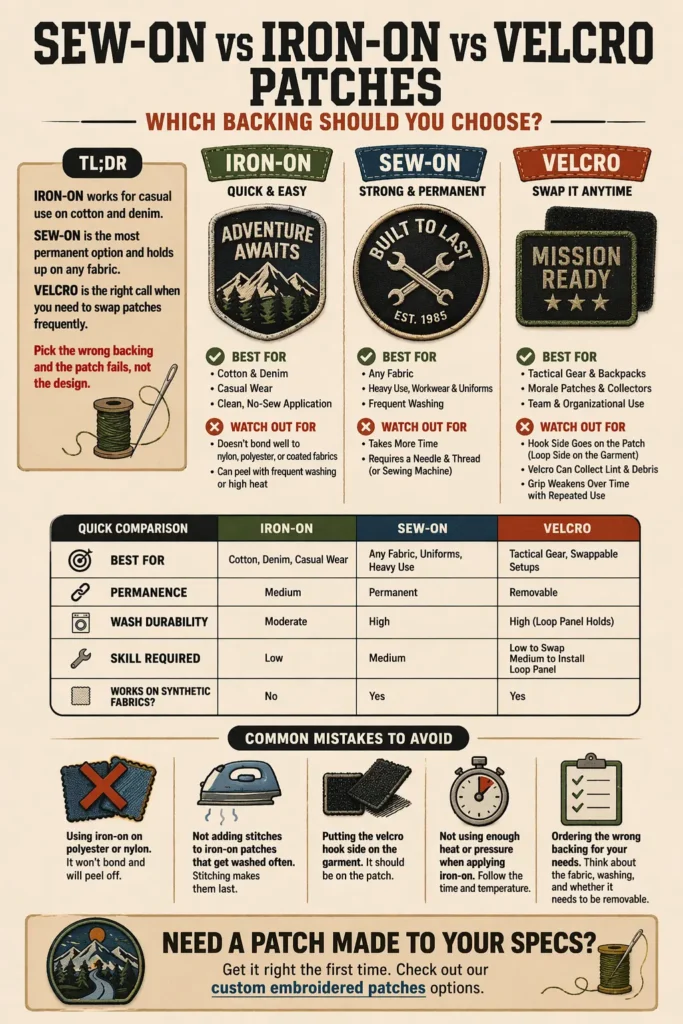
TL;DR: Iron-on works for casual use on cotton and denim. Sew-on is the most permanent option and holds up on any fabric. Velcro is the right call when you need to swap patches frequently. Pick the wrong backing and the patch fails, not the design. If you need a patch made to your specs with the correct backing already applied, see our custom embroidered patches options.
Backing is the part most people ignore until their patch falls off in the wash or peels at the edges after a week. The design gets all the attention. The backing does all the work.
This guide covers when each backing type makes sense, what it actually holds up against, and the mistakes that cause patches to fail before they should.
Why Backing Matters More Than You Think
A patch is only as good as what keeps it in place. The same embroidered design ordered with the wrong backing for the wrong fabric will fail regardless of how well it was made.
Backing affects how the patch applies, how long it lasts, whether it survives washing, and whether it can be repositioned or removed later. Getting this right at the ordering stage saves you from redoing the work.
Iron-On Patches
Iron-on patches have a heat-activated adhesive on the back. When you apply heat and pressure, the glue bonds to the fabric fibers.
When Iron-On Works
Iron-on is the right choice when:
- The garment is cotton, denim, or a cotton blend
- The patch is going on a flat, stable surface like a jacket back, sleeve, or bag
- You want a clean application without sewing
- The item will not be washed constantly or on high heat
For step-by-step application instructions, see our iron-on guide.
When Iron-On Fails
The adhesive bond weakens on:
- Nylon, polyester, and synthetic fabrics. The fibers do not absorb heat the same way, so the glue never fully bonds.
- Waterproof or coated materials. The coating blocks adhesion entirely.
- Stretchy or elastic fabric. Repeated stretching breaks the bond at the edges over time.
- High-wash items. Frequent washing in hot water degrades the adhesive faster than most people expect.
The FTC’s Care Labeling Rule (16 CFR Part 423) requires garment manufacturers to provide accurate washing instructions precisely because heat and cycle intensity affect applied materials, including patch adhesives. If you are unsure how your garment’s care label maps to patch durability, that regulation is the reference point: https://www.ecfr.gov/current/title-16/chapter-I/subchapter-D/part-423
If the fabric is not cotton-friendly or the item gets washed regularly, iron-on alone is not enough. Adding a few anchor stitches around the perimeter significantly extends the life of any iron-on patch.
Sew-On Patches
Sew-on patches have no adhesive backing. They are attached entirely by thread, either by hand or machine.
When Sew-On is the Right Call
Sew-on is the most permanent option available. It works on any fabric that can take a needle, including materials where iron-on will not bond.
Use sew-on when:
- The garment is nylon, polyester, leather, or a delicate material
- The patch needs to survive years of heavy use on workwear, uniforms, or gear bags
- The item will be washed frequently and on normal cycles
- You are attaching to curved or uneven surfaces like a hat brim or a stuffed item
Sew-on is also the preferred method for military, scout, and uniform applications where patch integrity is required over time. The BSA Guide to Awards and Insignia is the official reference for Scout uniform patch placement and specifies sewn patches throughout. If you are managing patches for a Scout uniform, that guide is the authoritative source: https://filestore.scouting.org/filestore/pdf/33066/33066_Scouts_BSA_Insignia_WEB.pdf
The Trade-Off
Sew-on takes more time and requires a needle, thread, and either hand stitching or a sewing machine. It is permanent. Removing a sewn-on patch typically leaves needle holes in the fabric.
If you are not confident with a needle, a tailor or alterations shop can sew patches down quickly and cleanly for a small fee.
Velcro Patches (Hook-and-Loop)
Velcro patches use a two-part hook-and-loop system. One side attaches to the patch. The other side is sewn or affixed to the garment. The patch peels off and reattaches as needed.
When Velcro Makes Sense
Velcro is the standard choice for:
- Tactical and military gear. OCP uniforms, plate carriers, chest rigs, and morale patch fields use hook-and-loop panels so patches can be swapped without sewing. Military-grade hook-and-loop must meet U.S. Commercial Item Description AA55126 (Rev. C), issued by the Defense Logistics Agency. Standard uniform applications use Type II, Class 1, which is woven nylon with selvage. If you are sourcing material for a regulated uniform application, verify against that spec: https://www.dla.mil/
- Bags, backpacks, and modular gear. Any setup where patches are rotated or customized regularly.
- Team and organizational use. When the same base garment needs to display different patches depending on the event, rank, or assignment.
- Collectors and enthusiasts. Morale patches are almost always sold with velcro backing for exactly this reason.
The convenience is the point. Velcro lets you change the patch without touching a needle or iron.
What to Watch For
- The hook side (rough side) goes on the patch. The loop side (soft side) goes on the garment or gear panel. Reversing this scratches the fabric.
- Velcro accumulates lint, pet hair, and debris over time. Clean the hooks with a stiff brush or tape to maintain grip.
- On thinner fabrics, the loop panel needs to be sewn down securely. Adhesive-backed loop panels exist but are not reliable on their own for long-term use.
- Velcro grip weakens gradually with repeated attachment and removal. High-cycle applications may need the loop panel replaced over time.
Quick Comparison
| Iron-On | Sew-On | Velcro | |
| Best for | Cotton, denim, casual wear | Any fabric, uniforms, heavy use | Tactical gear, swappable setups |
| Permanence | Medium | Permanent | Removable |
| Wash durability | Moderate | High | High (loop panel holds) |
| Skill required | Low | Medium | Low (to swap) / Medium (to install loop panel) |
| Works on synthetic fabrics | No | Yes | Yes |
Common Mistakes to Avoid
- Using iron-on on polyester or nylon. The adhesive will not bond correctly. The patch will peel, usually starting at the corners within a few washes.
- Not adding stitches to iron-on patches on items that get washed frequently. Iron-on alone is not designed for permanent heavy-wash use. Perimeter stitching is the fix.
- Putting the velcro hook side on the garment instead of the patch. The hook side against skin or fabric causes scratching and pulls on surrounding material.
- Applying iron-on without enough heat or pressure. Insufficient bonding is one of the most common reasons patches lift. Use a heat press or hold the iron firmly for the full recommended time. A household iron set too low will not activate the adhesive fully.
- Ordering the wrong backing for the end use. If you are unsure what backing your garment or gear requires, check with your unit SOP, supplier, or the manufacturer of the base item before ordering.
Ordering with the Right Backing
Most custom patch suppliers, including Teddy Patches, apply backing at the production stage. This means you need to know what backing you want before you order. Changing it after the fact usually means reordering.
When placing a custom order, think through:
- What material is the patch going on? Cotton needs iron-on or sew-on. Synthetics need sew-on or velcro.
- How often will it be washed? Daily-use items need sew-on or velcro with a stitched panel.
- Does it need to be removable? If yes, velcro is the only practical option.
- Is this for a uniform or regulated application? Check whether the governing body specifies a backing type.
If you need custom embroidered patches made with a specific backing already applied, that can be specified at the time of order.
Final Thoughts
The backing is a functional decision, not an afterthought. Iron-on is convenient for the right fabric. Sew-on is the most durable option across the board. Velcro is built for anything that needs to be swapped.
Choose based on what the patch actually has to survive, not just what is easiest to apply on the day.